

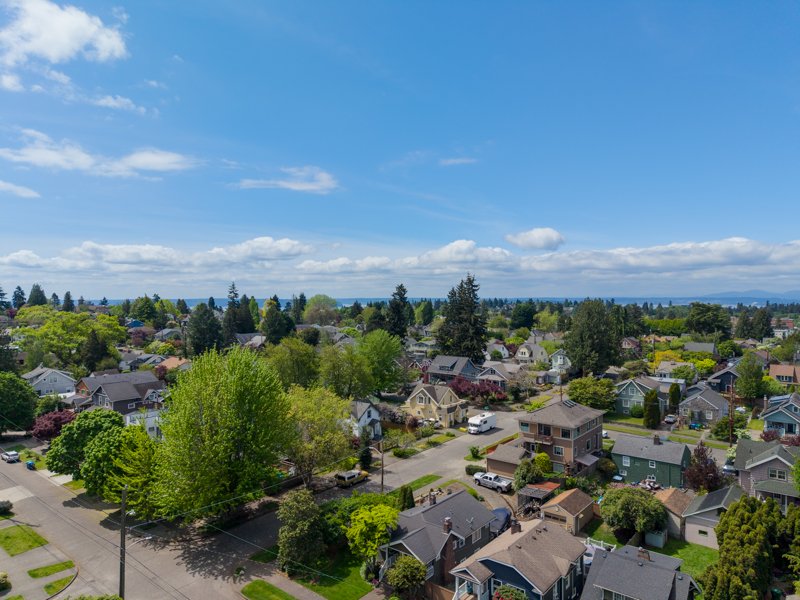
One of the easiest ways to tell Seattle wasn't built all at once is to look at the lots.
Some are clean rectangles. Some are long and narrow. Some are wedge-shaped. Some sit close to the sidewalk. Some have alley garages in back. Some look like they were cut out of whatever land was left over.
That's basically what happened.
Seattle grew in layers, and the lot lines still show it.
If you spend enough time looking at houses here, you start to realize that the lot is often one of the best clues to the history of the block. A house might be remodeled, added onto, or completely rebuilt, but the lot usually holds onto the older logic. It can tell you whether the neighborhood was platted early, whether the street grid had to deal with a steep hill, whether there used to be alley access, whether a small commercial node was nearby, or whether rail, shoreline, or industrial uses once shaped the land around it.
That's why Seattle can feel so block-by-block. The city wasn't master planned in one clean sweep. Different landowners platted different areas at different times, often based on what made sense for that piece of land in that moment. One area might have been laid out around walking and streetcars. Another around working waterfront uses. Another around a ridge, ravine, or hillside. Later, the city stitched those pieces together.
That's how you end up with lots that don't all follow the same pattern.
Old plats are a big reason for this. A plat is basically the original map that divides land into blocks, streets, and lots. In Seattle, many neighborhoods were subdivided before the city around them fully matured into what we think of now. So one owner might lay out a pretty regular grid, while the next owner over does something a little different. Later, streets get extended, utility expectations change, and houses are built across decades. The result can be a neighborhood where one block feels very orderly and the next one feels a little improvised.
You can see that all over Seattle. Ballard, Wallingford, Ravenna, Capitol Hill, Beacon Hill, West Seattle, and parts of the Central District all have places where the block pattern shifts in a way that becomes obvious once you start noticing lot size, alley placement, setbacks, and street width.
Topography is another huge reason Seattle lots look the way they do. This isn't a flat city. We have ridges, ravines, bluffs, shorelines, filled tidelands, and steep transitions between one street and the next. A lot that looks straightforward on a map can feel completely different in person once grade changes, retaining walls, or stair-step yards come into the picture.
That's part of why neighborhoods like Queen Anne, Magnolia, West Seattle, Capitol Hill, Mount Baker, Leschi, and Madrona can have lots that feel a little unusual even when their dimensions are technically normal. The slope changes how the land is usable. It changes where the house sits, where the garage works, where water moves, and whether the backyard feels generous or mostly theoretical.
Sometimes the oddness isn't the lot line itself. Sometimes it's the fact that the ground underneath the lot is doing a lot of work.
Seattle's history of regrades and land reshaping matters too. Parts of the city were literally cut down, filled in, or otherwise reworked so streets and development could happen. When a city changes grade, extends roads, straightens access, or fills tidelands, parcels can wind up with strange relationships to the street. A lot may be shallow in one direction, unusually elevated, or have an awkward retaining setup because the surrounding block was physically changed long before the current house existed.
That's one reason some lots feel a little strange near older urban or industrial parts of the city. The land may have been altered to make the broader neighborhood function, and the parcel pattern is carrying some of that history forward.
Alleys are another major piece of the puzzle. In many older Seattle neighborhoods, alleys were part of the original plan. That meant garbage, parking, garages, deliveries, and service access could happen from the back of the property instead of the front. Houses could sit closer to the street, front yards could stay simpler, and detached garages could live at the rear of the lot.
That creates a very different kind of property than a similar lot with no alley at all.
An alley lot can feel more functional because the front of the house isn't trying to do everything at once. You aren't always giving up the main facade to a driveway or garage door. In places like Ballard, Wallingford, Greenwood, Phinney Ridge, and parts of West Seattle, that pattern can be a real advantage. In other neighborhoods, where alleys are less common, driveways and front access tend to shape the way the property works instead.
That's also why two lots with similar square footage can live very differently.
Older neighborhood commercial nodes are another reason some lots feel off by modern standards. Seattle used to have more corner stores, small groceries, neighborhood businesses, and walkable commercial pockets woven directly into residential areas. Before daily life became more centered around big grocery stores, shopping centers, and car-oriented retail, plenty of neighborhoods had little nodes tucked into the blocks.
You still see traces of that in places like Wallingford, Ravenna, Capitol Hill, Columbia City, the Central District, and West Seattle. Some of those buildings are still commercial. Some have become homes, offices, salons, or studios. Some sit unusually close to the sidewalk or on lots that feel shallower, wider, or more exposed than the houses around them. That's often not random. It's a clue that the block used to serve a slightly different purpose.
Rail lines and industrial history created their own lot patterns too. Seattle has plenty of places where diagonal rail alignments, freight routes, shoreline industry, or utility corridors cut across what would otherwise have been a cleaner street grid. When that happens, somebody usually ends up with a wedge, a remnant parcel, a strange access easement, or a lot that looks simple until you try to understand how it's actually legally or physically organized.
I once came across a property that looked like an easy development play until old rail complications made a builder walk away. From the street, the lot looked straightforward. On paper, it was a different story.
That's part of why I'm careful about assuming a strange-looking lot is either a hidden gem or an obvious problem. Sometimes it's neither. Sometimes it's just carrying old city history that needs to be understood properly.
Modern infill has added another layer. Some unusual lot patterns in Seattle are old. Some are brand new. Townhouse development, condo plats, DADUs, backyard cottages, and lot splits have created a lot of newer parcel arrangements that didn't exist a generation ago. If you see a row of narrow homes where one older house used to sit, that's not 1910 Seattle showing through. That's current land use changing how the lot is organized.
That matters because buyers sometimes assume all narrow or unusual parcels are historical, when some are the result of very recent redevelopment. Both can be fine. They just raise different questions.
For buyers, the practical takeaway is that lot size alone doesn't tell you much. I care more about usable lot than headline lot size. A smaller but flatter lot with alley access, good light, and a real backyard may live better than a larger lot that's mostly slope, awkward side yard, retaining wall, or difficult access.
I want to know where the sun hits. Where the water goes. Whether the parking actually works. Whether the backyard is usable. Whether the lot shape creates privacy or takes it away. Whether there are easements, shared driveways, odd setbacks, retaining walls, or access issues that will matter later.
An unusual lot isn't automatically bad. Some of the best Seattle properties have quirks. A deeper lot might give you a great backyard. A corner lot might bring more light. An alley lot might make the whole property work better. A sloped lot might create privacy or a view that wouldn't exist otherwise.
But the shape is still telling you something.
For sellers, lot shape can be part of the property's quiet value. Depth, alley access, a flatter yard, useful corner positioning, better sun, extra privacy, or flexibility for future use can all matter. If the lot has a real strength, the marketing should explain it clearly instead of assuming buyers will automatically understand it from the photos.
And if the lot has tradeoffs, those need to be understood honestly too. A steep driveway, awkward parking, limited yard use, a narrow building envelope, or unusual access isn't something to hide. It's something to explain in context.
That's really the broader point.
Seattle lots look the way they do because Seattle grew in pieces. Old plats, hills, regrades, alleys, commercial corners, rail lines, shoreline history, and newer infill all left marks on the map. The lot is often a record of the version of Seattle that came before the house you're looking at now.
When I'm evaluating a property here, I'm not just looking at the house. I'm looking at how the house sits on the lot, how the lot fits into the block, and what the shape of that land is telling me about daily life, resale, and the history of the neighborhood.
In Seattle, the lot is rarely just background.
If you're buying a home in Seattle, visit my Seattle buying guide. If you're thinking of selling your home, start with my selling roadmap. Browse Seattle neighborhoods or learn more about me.