

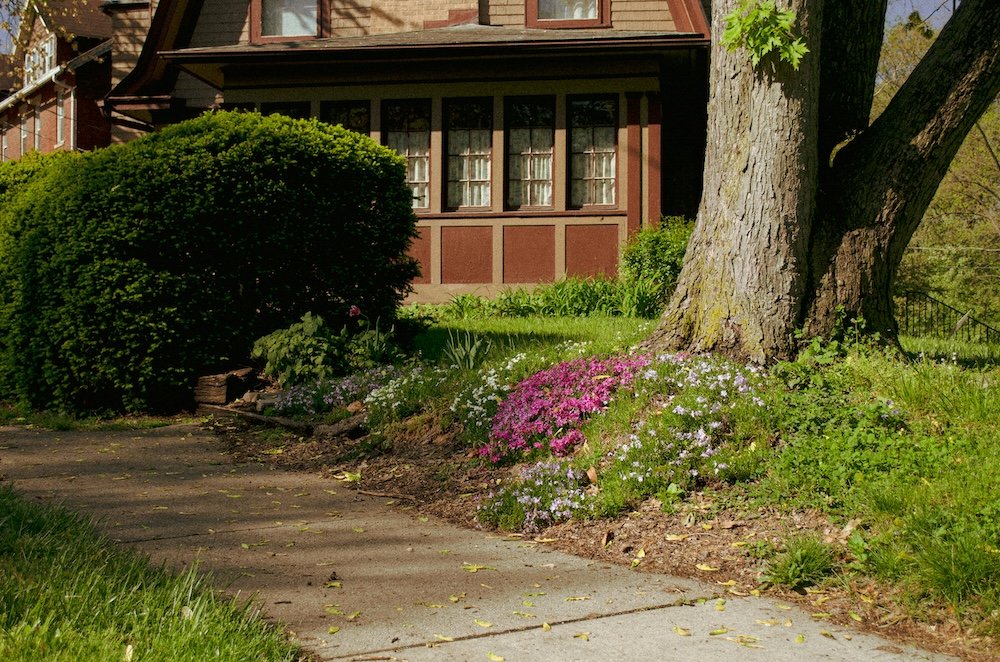
In Seattle, the space between a house and the street is often doing more work than it gets credit for: sidewalk, planting strip, street tree, curb, parking, drainage, roots, shade, power lines, and maybe a hedge or fence all packed into the first little stretch of the property experience.
That area can make a house feel established, private, and beautiful, or it can make the whole approach feel tight, dark, cracked, overgrown, slippery, or more expensive than expected. It’s also one of those Seattle things where the public-private line gets a little blurry, because the sidewalk and planting strip may feel like city space, but the adjacent homeowner may still have real maintenance responsibility.
This comes up a lot with older homes in neighborhoods like Wallingford, Queen Anne, Capitol Hill, Ravenna, Green Lake, Madrona, Leschi, West Seattle, Phinney Ridge, and Ballard, where mature trees and older sidewalks are part of the neighborhood feel. A block with big maples, chestnuts, cherries, elms, lindens, or old ornamental trees can look incredible in spring and fall, but those same trees may also be lifting panels, dropping leaves into drains, blocking light, or creating a mossy front walk that stays damp for half the year.
That’s the basic Seattle tradeoff with mature trees. They’re a huge part of why certain streets feel good, and they can add privacy, shade, softness, scale, and a sense that the block has been there for a long time. They also create real maintenance. Roots move sidewalks. Branches grow into power lines. Leaves clog gutters and drains. Shade can keep moss alive on steps, paths, roofs, and retaining walls. The same tree that makes the house look great from the street can also be the reason the front approach needs more attention.
The planting strip is a big part of this, especially in older residential areas where the space between the sidewalk and curb is wide enough to actually matter. Some are simple grass strips, some are full of roots and exposed soil, some have carefully planted gardens, and some are basically a small wild kingdom of rosemary, lavender, sword ferns, ornamental grasses, sedum, weeds, and whatever has survived the dogs, drought, rain, and garbage day. A nice planting strip can make a modest house feel much more cared for, while a neglected one can drag down the first impression before the house itself has a chance.
Parking interacts with all of this in a very Seattle way. A mature street tree can make a block feel beautiful, but it may also break up the curb, limit where cars can fit, or sit exactly where a passenger door wants to open. A planting strip with big roots or uneven ground can make curbside parking feel less convenient, especially on narrow streets where cars already park close to the edge. Add a fire hydrant, a driveway cut, a utility pole, a bike lane, or a corner sightline, and suddenly the “easy street parking” idea becomes more block-by-block than people expect.
Sidewalk condition matters too, and not just for looks. A cracked or lifted sidewalk changes how the home feels for strollers, wheelchairs, older relatives, delivery drivers, kids on scooters, dog walks, and anyone trying to get to the front door in the rain without doing a small obstacle course. Seattle has plenty of sidewalks that tell the story of tree roots, old concrete, drainage, and years of patching. In some neighborhoods, the sidewalk is part of the charm until someone catches a toe on it.
Seattle also has official sidewalk-clearance rules that sound pretty straightforward on paper and look much less straightforward when walking around the city. Property owners are expected to keep vegetation trimmed above the sidewalk, clear near the curb, and pulled back enough that the walkway remains usable, which makes sense given how much of Seattle’s sidewalk space already has to share room with planting strips, street trees, utility poles, uneven concrete, parked cars, and older curb layouts.
In practice, plenty of blocks don’t really meet that standard. Laurel hedges creep over the sidewalk, branches hang lower than they should, planting strips expand into the walking path, and a sidewalk that was probably fine years ago slowly becomes narrower and darker. It’s not usually dramatic, but it changes how the front of a property feels, especially in neighborhoods where mature landscaping is part of the appeal.
For a home, that front edge matters. A clear sidewalk and maintained planting strip can make the property feel cared for before anyone reaches the front door, while overgrowth can make the same house feel more closed off, shaded, or neglected. Seattle has a lot of landscaping that’s beautiful because it’s a little loose and mature, but there’s still a difference between lush and poorly maintained.
This is where homeowners can be surprised, because a sidewalk may feel like city infrastructure, but adjacent property owners are generally responsible for keeping sidewalks safe and in good repair. That doesn’t mean every crack is a panic item, and it doesn’t mean every sidewalk issue is handled the same way, but it does mean a buyer shouldn’t assume the city automatically fixes every broken panel just because it’s in the public right-of-way. The right-of-way is one of those phrases that sounds bureaucratic until it affects a house directly.
Street trees are similar. Some are city-planted and city-maintained, while others were planted privately and may be the adjacent owner’s responsibility to maintain, even though SDOT still regulates street trees in the right-of-way. That’s a strange arrangement if nobody has explained it before, because the tree may feel public, the sidewalk may feel public, and the planting strip may feel public, but the practical maintenance can still land very close to the homeowner.
This is also why tree work in Seattle isn’t always as simple as calling someone with a chainsaw and making a Saturday out of it. Street trees are regulated, and private-property trees can also be subject to Seattle’s tree rules depending on size, species, location, construction plans, and other details. Tree canopy is a real city priority, which makes sense because trees are part of Seattle’s identity, but it also means trees aren’t just landscaping in the way a shrub or a flower bed is landscaping.
For buyers, the point isn’t to avoid houses with big trees. That would be a weird way to shop in Seattle, and it would also eliminate some of the best blocks in the city. The point is to understand what the trees are doing for the property and what they may ask for in return. A big tree might give the house privacy from the street, shade the front rooms in summer, soften the view from upstairs, and make the whole block feel better. It might also be close to the sewer line, lifting the sidewalk, crowding the roof, or dropping enough organic material to keep gutters and drains busy.
Power lines add another layer because the best tree from a curb appeal standpoint may not be the best tree from a utility standpoint. On some blocks, trees have been pruned into odd shapes to keep them away from overhead lines, which can make one side of the street feel very different from the other. A block with buried utilities may have a fuller canopy and cleaner views, while a block with overhead lines may have more visual clutter, more aggressive pruning, and trees that never quite get to grow naturally.
That difference can affect views too. A home in Admiral, Alki, Queen Anne, Magnolia, Leschi, Madrona, or Mount Baker may have a view that depends on the exact relationship between the house, the street trees, the neighboring trees, the power lines, and the slope. A tree can frame a view, block a view, improve privacy, reduce glare, or become a future argument if one neighbor’s “beautiful canopy” is another neighbor’s lost outlook.
There’s also a neighborhood-character piece that’s hard to measure but easy to feel. A mature tree-lined street in Wallingford or Ravenna feels different from a newer townhome block with smaller trees, tighter setbacks, and a thinner planting strip. Neither version is automatically better, and the newer block may offer more homes, newer systems, cleaner sidewalks, and less exterior maintenance. Still, the older tree canopy is part of what people are often responding to when they say a block feels “classic Seattle.”
New construction changes this dynamic in a few ways. A redeveloped lot may get new sidewalks, new planting strips, new street trees, new curb cuts, new utility work, and a cleaner frontage than the older house had before. That can be a real improvement. It can also make the block feel younger and less settled for a while, especially if mature trees came down and the replacement trees are still small enough to look like decorative sticks with optimism attached.
The tree conversation gets emotional because people aren’t only talking about arborist reports and sidewalk panels. They’re talking about shade, birds, privacy, neighborhood memory, leaf piles, storm cleanup, roots, blocked light, insurance worries, and whether a street still feels like the street they remember. It’s the kind of thing that shows up in neighborhood Facebook groups and Reddit threads because everyone has a tree opinion once the tree is close enough to their house, car, roof, sewer line, or view.
Sellers should think about this before photos and showings, because the front edge of the property sets the tone quickly. Overgrown vegetation, mossy steps, low branches, cracked walkways, weeds in the planting strip, and a sidewalk that feels neglected can make a home feel like deferred maintenance before anyone has even looked at the roof or basement. A clean, maintained frontage can do the opposite. It makes the house feel cared for in a way buyers notice even if they don’t consciously name it.
For buyers, street trees and sidewalks are part of the real estate, not just scenery around it. The questions are practical, but they’re also about how the home feels. Does the tree make the home private or dark? Does the sidewalk feel safe and usable? Does the planting strip help the curb appeal or create maintenance? Are roots affecting concrete, drains, sewer, or retaining walls? Are power lines shaping the canopy? Does the block feel established, overgrown, bare, or newly rebuilt?
A house with mature trees, a planted strip, and an older sidewalk may have more charm and more maintenance. A newer home with a fresh sidewalk and small young trees may be easier now but less shaded, less private, and less rooted into the block. A home on a street with no sidewalks may feel quieter and more informal, but it may be less convenient for walking, kids, strollers, guests, or aging in place.
That’s the Seattle part of it. The street edge tells a lot about how a home fits into the neighborhood. Before the front door, before the kitchen, before the view from the back deck, there’s the first stretch from curb to entry, and in Seattle that little stretch can carry a surprising amount of information.
If you're buying a home in Seattle, visit my Seattle buying guide. If you're thinking of selling your home, start with my selling roadmap. Browse Seattle neighborhoods or learn more about me.