

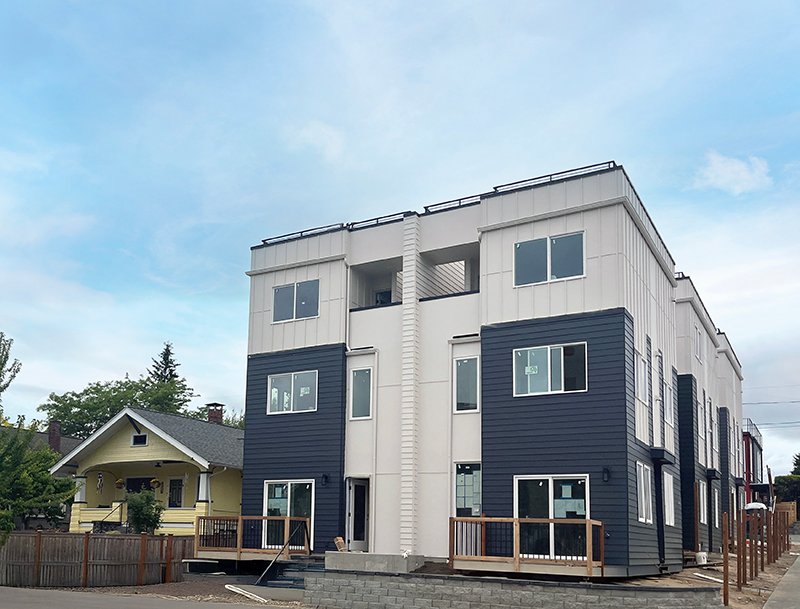
I had a client ask me about two properties that looked almost identical from the outside. One was a townhouse and one was a condo. The short version is that a townhouse is usually its own lot on a townhouse plat, while a condo typically involves shared ownership of the building or common elements through an HOA. That ownership structure affects maintenance, insurance, dues, financing questions, and what you're actually buying.
Seattle housing used to feel a little easier to categorize.
There were single-family houses on quieter residential streets, townhouses and apartments on busier arterials, and condos in denser neighborhoods like Capitol Hill, First Hill, Belltown, Downtown, and parts of Queen Anne. That was never perfectly true, but it was a basic pattern you could see pretty clearly if you grew up here or spent enough time driving around the city.
That line is a lot blurrier now.
A single-family lot in Seattle doesn't necessarily mean “one house forever.” The city has changed, zoning has changed, housing demand has changed, and builders are looking at lots very differently than they did even 10 or 15 years ago. A small older house on a large lot might still be someone’s dream home, but it might also be a redevelopment candidate if the numbers work for a builder.
That doesn't mean every older house is about to be torn down. It's not that simple. A developer has to look at land cost, construction cost, financing, zoning, tree rules, utilities, side sewers, access, parking, market demand, resale value, and whether the whole thing actually pencils out. I once came across a house ripe for development that a builder wouldn't touch because of complications with unused old train tracks. But the possibility is real in a way that buyers and sellers should understand.
One of the things I notice when walking Seattle neighborhoods is how much history is still hiding in plain sight. If you look closely, you’ll sometimes see older homes or buildings with almost no setback from the sidewalk. A lot of those properties are clues from an earlier version of the city, when small corner stores and neighborhood shops were sprinkled through residential areas. Before the current pattern of bigger shopping centers, grocery chains, and car-oriented retail, many neighborhoods had little commercial nodes tucked into everyday life.
Some of those old corner-store buildings still exist. Some are now homes. Some are offices. Some are tiny restaurants, salons, studios, or shops. They’re a reminder that Seattle neighborhoods were never as purely residential as people sometimes imagine. The city has always been layered. What’s changing now is the scale and speed of those layers.
Single-family homes are still what a lot of people picture when they think about buying a house in Seattle. A standalone home, a yard, maybe a driveway, maybe a garage, maybe some original character. Older Craftsmans, bungalows, Tudors, mid-century homes, and postwar houses all have a real appeal here. I understand why people are drawn to them. A home with character, usable outdoor space, and a quieter residential feel can be very compelling.
In Seattle, a single-family home is usually the most expensive housing option, especially in central or highly desirable neighborhoods. It can come with more privacy and more control, but also more responsibility. Roof, sewer, drainage, foundation, landscaping, exterior maintenance, heating systems, windows, and old-house quirks all fall on the owner. For some people, that’s the right fit. For others, it’s more work than they want.
Townhomes are the housing type that has probably changed Seattle the most visually over the last couple decades. They show up on former single-family lots, along arterials, near commercial areas, and increasingly in places that used to feel much more house-oriented. Builders like them because they can create multiple homes on a lot where one older house used to sit. Buyers often like them because they can offer newer construction, lower maintenance, and a location that might otherwise be out of reach for a detached house.
The honest version is that not everyone wants a townhouse.
Some people do. They like the newer systems, lower exterior maintenance, efficient layouts, rooftop decks, and the ability to live closer to a neighborhood center. But other people really want a house. They want a yard, storage, privacy, fewer stairs, room for kids or dogs, and a more traditional neighborhood feel. That’s not wrong. It’s just a real preference.
Townhomes also vary a lot. Some are well designed and live comfortably. Others feel like every decision was made to maximize unit count rather than day-to-day function. Stairs, parking, storage, garbage access, bike storage, package delivery, noise transfer, natural light, and main-floor layout all matter. A townhouse can be a great fit, but it needs to be judged as a home, not just as a newer and cheaper substitute for a detached house.
Condos are different again. A condo usually means owning the interior of a unit and sharing responsibility for the building, land, and common areas through an HOA. That can be a good fit for someone who wants less exterior maintenance, more central location, secure parking, amenities, or a lock-and-leave lifestyle. It can also be a way to buy into neighborhoods where detached houses are completely out of reach.
But condos require a different kind of due diligence. The unit matters, but the building matters just as much. HOA dues, reserves, rental caps, pet rules, insurance, assessments, maintenance history, litigation, parking, storage, elevators, roof condition, and building management can all affect whether a condo is a good purchase. A cheap-looking condo isn't always cheap once the monthly dues and building history are understood.
The word “condo” can also be confusing in Seattle because some newer townhome projects are legally structured as condominiums. To a buyer, it may look and feel like a townhouse, but legally it may be a condo with shared ownership elements and an association. That's not automatically bad, but it changes the paperwork and the questions that need to be asked. How is maintenance handled? What is shared? What are the dues? What is insured individually versus collectively? Those details matter.
Tiny houses and very small housing options are a smaller part of the conversation, but they’re worth mentioning because Seattle has a lot of people interested in living with less space. Sometimes that means an actual tiny house. More often, in Seattle real estate, it means small cottages, DADUs, backyard units, micro-units, small condos, or compact townhomes. The idea is appealing: lower cost, less maintenance, efficient space, and possibly a better location.
The tradeoff is obvious once you live with it. Storage, parking, pets, kids, hobbies, guests, laundry, outdoor space, and working from home all become more important in a small space. A tiny or compact home can work very well for the right person, but it has to be honest about how life actually functions. Seattle isn't a place where square footage is cheap, so small homes can make sense, but the layout has to work hard.
The bigger change is that Seattle is moving away from the old idea that most residential lots are only for one detached house. In 2025, Seattle adopted new middle housing rules to comply with state requirements, allowing more housing types such as townhouses, stacked flats, multiplexes, and cottage housing in residential zones. City materials describe the new rules as allowing up to four units on every residential lot, and up to six units in certain cases, such as near major transit or when affordable housing is included.
That's a big shift, but it's not the same as saying every block will change overnight. What gets built will still depend on feasibility. Some lots are too small, too steep, too constrained, too expensive, or too complicated. Some existing homes are too valuable to tear down. Some trees, utilities, access issues, or site conditions make redevelopment harder. A zoning change creates possibility. It doesn't automatically create a project.
For homeowners, this means the land may matter more than ever. A modest older house on a good lot may have value not only as a home, but as land with future potential. That can be good for the owner, but it can also change the feel of a block over time. A small Craftsman next to a new multi-unit project is becoming a more common Seattle sight.
For buyers, it means the surrounding lots matter. It's not enough to look only at the house. What could happen next door? Is the block likely to stay mostly the same, or is it positioned for more redevelopment? Are there alleys, large lots, underbuilt parcels, or older homes that might attract builders? A house can feel very different if the scale around it changes.
For sellers, it means pricing and positioning can be more nuanced. Some buyers are shopping emotionally for a home. Some are looking at the lot. Some are builders or investors. Some want the existing house preserved. Some are trying to understand future use. The right strategy depends on who the likely buyer is and what the property really offers.
None of this has to be framed negatively. Seattle needs more housing options, and a lot of people benefit from townhomes, condos, ADUs, and smaller homes. Not everyone can or wants to buy a detached house. More housing types can help people live closer to jobs, transit, schools, parks, and neighborhood centers.
At the same time, it's fair to say that something gets lost when every older house is treated only as a lot. Neighborhood character matters. Yards matter. Old homes matter. Quiet streets matter. Places where kids can play outside matter. The best version of Seattle growth should make room for more people without pretending the existing fabric of the city has no value.
That's why I think the real conversation is less about one housing type being better than another and more about fit, tradeoffs, and context.
A single-family home can offer space, privacy, character, and control, but usually costs more and requires more maintenance. A townhouse can offer newer construction and location, but may come with stairs, less storage, tighter parking, and less outdoor space. A condo can offer convenience and access, but the building and HOA matter as much as the unit. A tiny or compact home can be efficient and affordable by Seattle standards, but the layout has to be very honest about daily life.
Seattle housing is changing quickly, and the old categories don't always explain what you're really buying anymore. That's where good guidance matters. The question isn't just whether something is a house, townhouse, condo, or tiny home. The question is how it lives, what responsibilities come with it, what may happen around it, and how it fits into the way someone actually wants to live.
If you're buying a home in Seattle, visit my Seattle buying guide. If you're thinking of selling your home, start with my selling roadmap. Browse Seattle neighborhoods or learn more about me.