

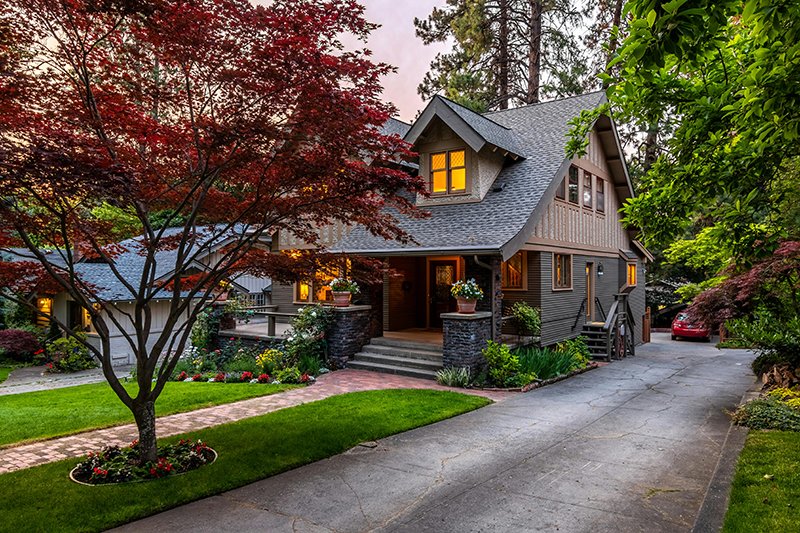
Seattle’s housing stock reads like a timeline. The styles that show up across the city aren’t random, and they’re not evenly distributed. They follow when neighborhoods were built, how quickly they developed, and what people expected out of a home at that point in time. Once you start to see that, it becomes easier to understand why different parts of Seattle feel the way they do.
The earliest large wave of housing you see across Seattle is Craftsman. These homes came out of the Arts and Crafts movement in the early 1900s, at a time when the city was growing quickly but still being built at a human scale. They show up in neighborhoods that were connected by streetcar lines like Phinney Ridge, Wallingford, Ballard, and the Central District. The design focuses on proportion, natural materials, and visible detail. Front porches, built-ins, and defined living spaces weren’t just stylistic choices, they supported how people actually used their homes day to day. A lot of what makes these neighborhoods feel cohesive today comes from how consistently these homes were built within a relatively short window of time.
Tudor homes follow not long after, mostly in the 1920s and 30s, and you tend to see them in areas that developed with a bit more space and intention behind them. Ravenna, Bryant, Laurelhurst, and parts of Queen Anne are good examples. Compared to Craftsman homes, Tudors feel more vertical and more formal. Steeper roofs, masonry exteriors, and more segmented interiors reflect a different idea of what a home should be. These were often built on larger lots, and that spacing still shows today in how those neighborhoods feel compared to denser Craftsman areas.
After World War II, the city expands outward in a more deliberate way, and the housing changes with it. Mid-century homes start to define areas like Wedgwood, View Ridge, and much of North Seattle. These homes are simpler in form but more open in how they live. Larger windows, fewer formal rooms, and a stronger connection to the yard reflect a shift in lifestyle. Cars become more central, lots get wider, and homes stretch out horizontally instead of stacking detail vertically. When these homes are updated well, they tend to feel more aligned with modern living than many earlier styles.
By the 1960s and 70s, a lot of what gets built is driven less by architectural philosophy and more by efficiency. Split-level and tri-level homes show up everywhere there’s a need to work with slope or maximize square footage without increasing cost too much. They’re common throughout North Seattle and the Eastside. These homes don’t have the same identity as Craftsman or Tudor, but they solve practical problems, and that’s why they’re still a big part of the housing mix.
More recent construction, especially from the early 2000s onward, reflects a different set of pressures. Land is more expensive, zoning is tighter, and demand is higher. Modern homes and townhomes fill in wherever redevelopment is possible, particularly in Ballard, Fremont, Capitol Hill, and West Seattle. These homes prioritize efficiency, light, and open layouts, often building upward rather than outward. They’re less tied to a single architectural movement and more shaped by constraints and current preferences.
What stands out in Seattle is how clearly these eras show up on the ground. Some neighborhoods are almost entirely defined by one period, which gives them a strong identity and consistency. Others are layered, where older homes sit alongside newer construction, and that mix changes how those areas feel and perform over time. That’s part of why two homes in the same neighborhood can behave very differently in the market.
At the same time, very few of these homes exist today exactly as they were originally built. Craftsman and Tudor homes have often been opened up, kitchens expanded, and systems updated. Mid-century homes are frequently remodeled to enhance light and flow while keeping their core structure. Even split-level homes, which were once seen as dated, are being reworked into more usable, modern layouts. What you end up with across Seattle is a housing stock that reflects its original era but has gradually adapted to how people live now. That blend of old structure and updated function is part of what makes buying here more nuanced, and often more interesting, than it looks at first glance.
Understanding Seattle home styles isn’t really about architecture in the abstract. It’s a way to read how the city developed, and that context carries through into pricing, demand, and how homes actually live today. Once you see those patterns, it becomes easier to evaluate not just the house, but the neighborhood around it.